

PCR-Based Circular Supply Chain Platform Market to Reach USD 4,260 Million by 2036 at 13.7% CAGR
PCR-Based Circular Supply Chain Platform Market
Market set for strong growth as digital compliance, traceability, and circular sourcing drive enterprise adoption through 2036.
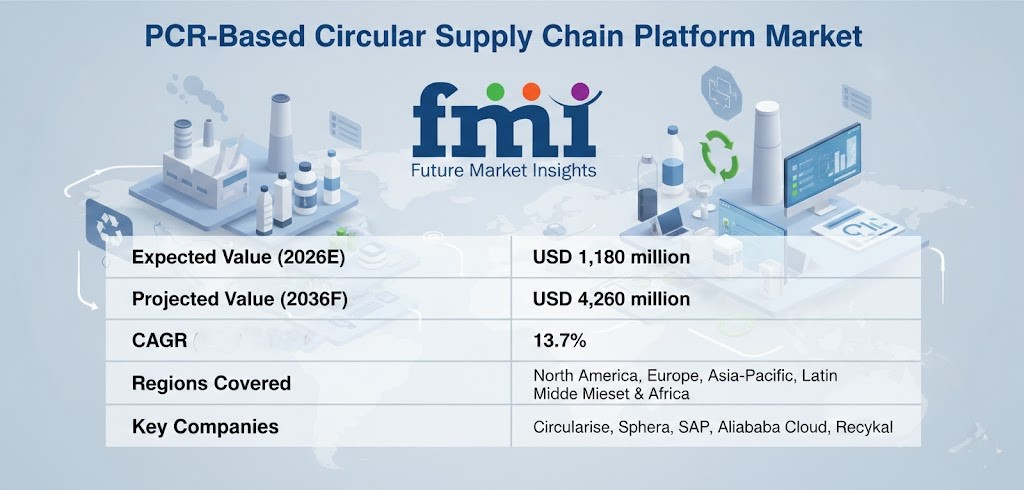
NEWARK, DE, UNITED STATES, February 16, 2026 /EINPresswire.com/ -- The global PCR-Based Circular Supply Chain Platform Market is projected to grow from USD 1,180 million in 2026 to USD 4,260 million by 2036, expanding at a CAGR of 13.7%. This growth reflects the market’s evolution from pilot-scale traceability initiatives to enterprise-grade systems designed for compliance, operational efficiency, and verified circular sourcing. As digital product passport requirements and enterprise sustainability mandates gain traction, these platforms are becoming essential infrastructure for managing post-consumer recycled materials across complex supply networks.
Market snapshot:
Market size (2026): USD 1,180 million
Market size (2036): USD 4,260 million
CAGR (2026–2036): 13.7%
Leading product segments: Baking accessories (25.6%); grilling & frying (45.1%)
Leading material type: Disposable (58.1%)
Leading end use: Residential (51.9%)
Key growth regions: European Union, USA, China, India, Japan
Top companies: Circularise, Sphera Solutions GmbH, SAP SE, Salesforce Inc., AntChain, Alibaba Cloud, Recykal
Request For Sample Report | Customize Report |purchase Full Report - https://www.futuremarketinsights.com/reports/sample/rep-gb-31995
Market Momentum
The PCR-Based Circular Supply Chain Platform Market is following a clear upward trajectory as digital traceability becomes integral to market access. The market sits at USD 1,180 million in 2026 and accelerates steadily through 2028 as digital product passport initiatives mature and enterprises adopt integrated compliance tools. Momentum strengthens further in 2030 and 2031 as enterprise-wide deployments replace fragmented systems. By 2033, adoption shifts toward intelligence-driven platforms that integrate verification, reporting, and sourcing optimization. By 2035, the market approaches maturity ahead of reaching USD 4,260 million by 2036, supported by large-scale operational integration and standardized digital reporting practices.
Segment Spotlight
Product Type
Grilling & frying leads with a 45.1% share, reflecting strong demand for comprehensive workflows that manage sourcing, supplier coordination, and compliance reporting. The segment’s leadership highlights how enterprises increasingly prioritize solutions capable of handling end-to-end operational requirements rather than isolated data storage.
Material Type
Disposable materials account for 58.1% of the market, underscoring the importance of hygiene, operational efficiency, and simplified cleanup in material verification processes. Platforms supporting disposable material flows help organizations reduce administrative complexity while ensuring compliance with traceability requirements.
End Use
Residential applications hold a 51.9% share, reflecting the rise of home-centric sustainability expectations and the growing importance of transparent sourcing data throughout consumer-facing product supply chains. This segment emphasizes the need for digital tools that can scale from supplier networks to end-market transparency demands.
Drivers, Opportunities, Trends, Challenges
Drivers: Financial institutions and investors increasingly require detailed ESG data, encouraging companies to adopt platforms that generate auditable sustainability reports. Regulatory mandates and verification demands further accelerate adoption.
Opportunities: Platforms are evolving toward marketplace models that enable financial transactions, supplier discovery, and recycled content credit trading. These capabilities convert compliance tools into revenue-generating ecosystems.
Trends: AI and machine learning are emerging as core features for anomaly detection, certificate validation, and predictive supply-chain insights. Blockchain-based verification and mass balance tracking also shape global adoption patterns.
Challenges: A lack of universal data standards and interoperability remains a major restraint. Platforms must support multiple protocols and certificate systems, increasing technical complexity and deployment costs.
Country Growth Outlook (CAGR)
Country-level performance in the PCR-Based Circular Supply Chain Platform Market highlights strong momentum across emerging and industrial economies. India leads global expansion with a projected CAGR of 15.4% from 2026 to 2036, followed closely by China at 14.6%, driven by digitalization and circular economy alignment.
The USA is expected to grow at a 12.8% CAGR as enterprises navigate multi-state compliance and sustainability commitments. Germany follows with a 12.4% CAGR, supported by EU digital product passport mandates and advanced industrial adoption. Brazil records an 11.6% CAGR, reflecting opportunities linked to agri-industrial packaging and reverse logistics programs. Japan, growing at 9.6% CAGR, emphasizes high-precision tracking and export-oriented quality compliance, rounding out the country growth outlook for the forecast period.
Competitive Landscape
Competition in the PCR-Based Circular Supply Chain Platform Market centers on ecosystem scale and deep enterprise integration. Providers are moving beyond standalone traceability toward interconnected networks that combine logistics, certification, and compliance workflows. Collaboration strategies are shaping the landscape, illustrated by initiatives involving BASF and Circularise to scale digital mass-balance solutions, the advancement of DPP models through CIRPASS pilots, and blockchain-enabled material tracking expansion by IBM and Plastic Bank. The market increasingly rewards platforms that build broad partner networks and interoperable architectures.
FAQ
What is the long-term growth outlook for the PCR-Based Circular Supply Chain Platform Market?
The market is forecast to expand from USD 1,180 million in 2026 to USD 4,260 million by 2036 at a CAGR of 13.7%, supported by the growing importance of compliance and circular operations.
How is the market expected to evolve structurally?
Platforms are expected to evolve from standalone traceability tools into integrated operational systems combining logistics optimization, compliance automation, and financial workflows.
Which geographies are strategically important?
The European Union, the USA, China, India, and Japan are key regions due to regulatory maturity, enterprise ESG adoption, and industrial digitalization initiatives.
What is driving adoption?
The transition from voluntary recycled content claims to mandatory verified digital records is creating non-discretionary demand for enterprise platforms.
What trends are shaping the market?
Blockchain-based verification, mass balance models, AI-led anomaly detection, and embedded circularity within enterprise systems are major defining trends.
Why FMI: https://www.futuremarketinsights.com/why-fmi
Browse Related Insights
Circular Cold-Chain Packaging Systems for Fresh & Frozen Food Market : https://www.futuremarketinsights.com/reports/circular-cold-chain-packaging-systems-for-fresh-frozen-food-market
Chain-of-Custody Packaging Solutions Market : https://www.futuremarketinsights.com/reports/chain-of-custody-packaging-solutions-market
Circular Plastic Packaging Ecosystem Market : https://www.futuremarketinsights.com/reports/circular-plastic-packaging-ecosystem-market
About Future Market Insights (FMI)
Future Market Insights, Inc. (FMI) is an ESOMAR-certified, ISO 9001:2015 market research and consulting organization, trusted by Fortune 500 clients and global enterprises. With operations in the U.S., UK, India, and Dubai, FMI provides data-backed insights and strategic intelligence across 30+ industries and 1200 markets worldwide
Sudip Saha
Future Market Insights Inc.
+1 347-918-3531
email us here
Legal Disclaimer:
EIN Presswire provides this news content "as is" without warranty of any kind. We do not accept any responsibility or liability for the accuracy, content, images, videos, licenses, completeness, legality, or reliability of the information contained in this article. If you have any complaints or copyright issues related to this article, kindly contact the author above.
